
Episode 39: The Homeric Question
In this episode we consider the complex history of the Homeric epic poem, the Iliad. Who was Homer? When did he live? Did he exist? Were oral poets able to tell such a long story (it takes about a day to narrate the whole)? Was writing necessary for such a tight and coherent structure? After giving an account what the ancient Greeks thought (who did not agree), we trace the different ways that modern scholars have analyzed the text and offer a modern theory of its evolution.
Regarding Homer’s life (if he in fact existed as one person), several ancient towns claimed to the the birthplace of Homer. Here’s a map of some of the more common ones we find.
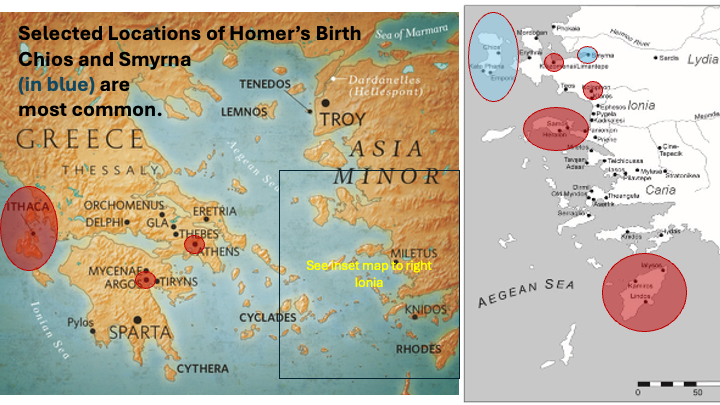
A map of some locations that claimed to be the birthplace of Homer. He is most associated with Ionia, which is south of Troy an the location of the Greek dialect closest to Homer’s artificial literary language.
A recent book presents a new set of arguments on the origin of the Homeric text. Mary R. Bachvarova’s From Hittite to Homer: The Anatolian Background of Ancient Greek Epic presents a case that moves the origins of the Trojan War back to the 11th century, where bilingual poets (that is, in Greek and Hittite, a Bronze age people with a rich mythological tradition) transmitted storylines from the Hittites to Greek-speaking bards, who adapted them (i.e. bards like “Homer”). Scholars have long known that the Greeks borrowed themes from older cultures in the east, but most argue this transmission happened in the 8th and 7th centuries, during the “Orientalizing Period.” Bachvarova argues for an earlier, Bronze Age connection—and one that places it chronologically closer to the supposed date of the Trojan War. As Yoram Cohen in his review of the book for the Bryn Mawr Classical Review writes:
Previous scholarship on the relation between ancient Near Eastern literature and Greek epic (e.g., Walter Burkert and Martin West; see, e.g., p. 262) has usually claimed that the Orientalizing Period was the time frame in which transmission from east to west took place. It was argued that travelling poets from the Semitic world on the Syrian littoral in an age of Neo-Assyrian globalism transmitted, whether orally or in writing, mythological and epic narratives to Greeks around the eastern Mediterranean.
Bachvarova certainly does not deny the existence of these transmission routes (pp. 285–294). However, by picking up on the very suggestive scholarship of Calvert Watkins, she argues for a much earlier and an equally, if not a more substantial, transmission that happened by a different route and by somewhat other means. Positing that a pre-Homeric early Iliad (in oral form) was already around in the 11 th century, she advances the thesis that wandering bards were the ones responsible for transmission: Phrygians perhaps or earlier peoples who kept alive an oral heritage from Late Bronze Anatolia, and who were fluent to some degree in both Greek and some Anatolian language (hence bilingual), delivered songs in cultic commemorations of the dead at the courts of aspiring dynasts on the Ionian coast (chs. 15–16, and passim, e.g., p. 300). The memory of the once prosperous Late Bronze Age Troy , now in ruins, was the stage where Anatolians and Greeks could play out their mutual present (ch. 14, and p. 373). Orally transmitted through narrative song, the story-lines of ancient Near Eastern and Hittite epic and myth about a famous destroyed city (Ebla) and a long-dead hero-king (Naram-Sin) were threads of a fabric in the making – the Iliad.
Without pressing the issue too much, this is basically saying that “Homer” is a cypher for bilingual poets in central and western Anatolia, where the framework for the Iliad first took shape.
Credits:
Written and Narrated by R. Scott Smith
Sound Engineering and Voice Acting by Jackson Scheele
Music by Jared Sims