
The Christopher Nolan film the Odyssey is all the rage right now, but before his wanderings could take place Troy had to fall. Of course, the most vivid portrayal of the war itself is the Iliad, which shows the horrors of war but only really recounts a part of the tenth year and does not even narrate the fall of Troy. Instead, it focuses on Achilles and his psychological turmoil as he tries to negotiate Agamemnon’s insults and his role in a very messed up war. Like the Odyssey, the Iliad is brilliant not because it involves the mythical war, but because it fixates on the human troubles of a flawed character. Great thanks go to Nicole Sanfilippo who researched and wrote the script.
Because this episode is about the text, there are only a few images. We recommend that you read the Iliad before listening, or at least read a reliable summary. Our hope is once you listen to the podcast, you’ll want to go (re-)read this masterpiece of storytelling.
Agamemnon’s men taking Achilles’ war-prize, Briseis
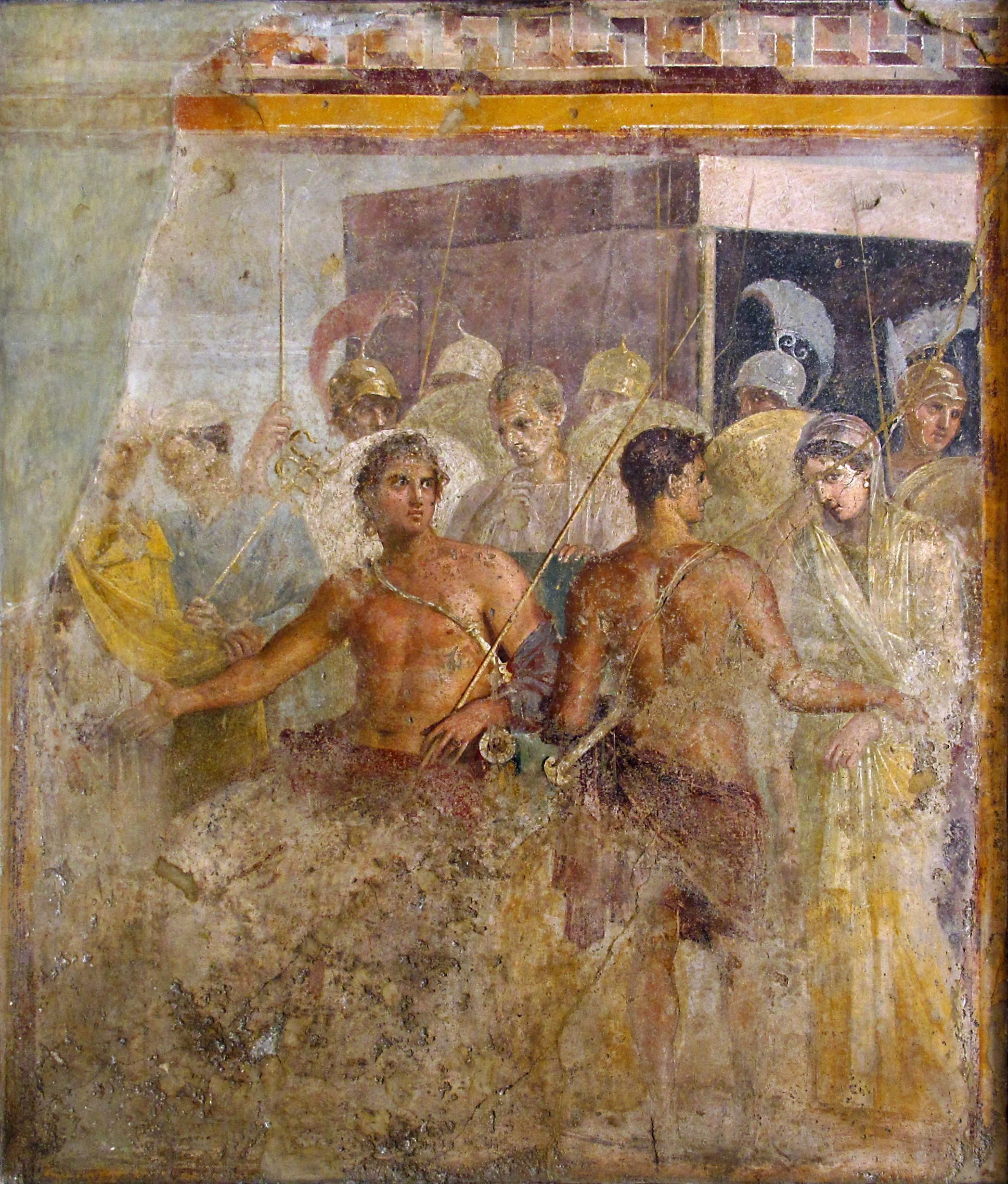
Wall painting from Pompeii (in the atrium of the House of the Tragic Poet, fourth style, ca. 75 AD). Achilles, in the center, watching on as a herald of Agamemnon takes Briseis, to the right, away.
Achilles drags Hector’s corpse around Patroclus’ tomb
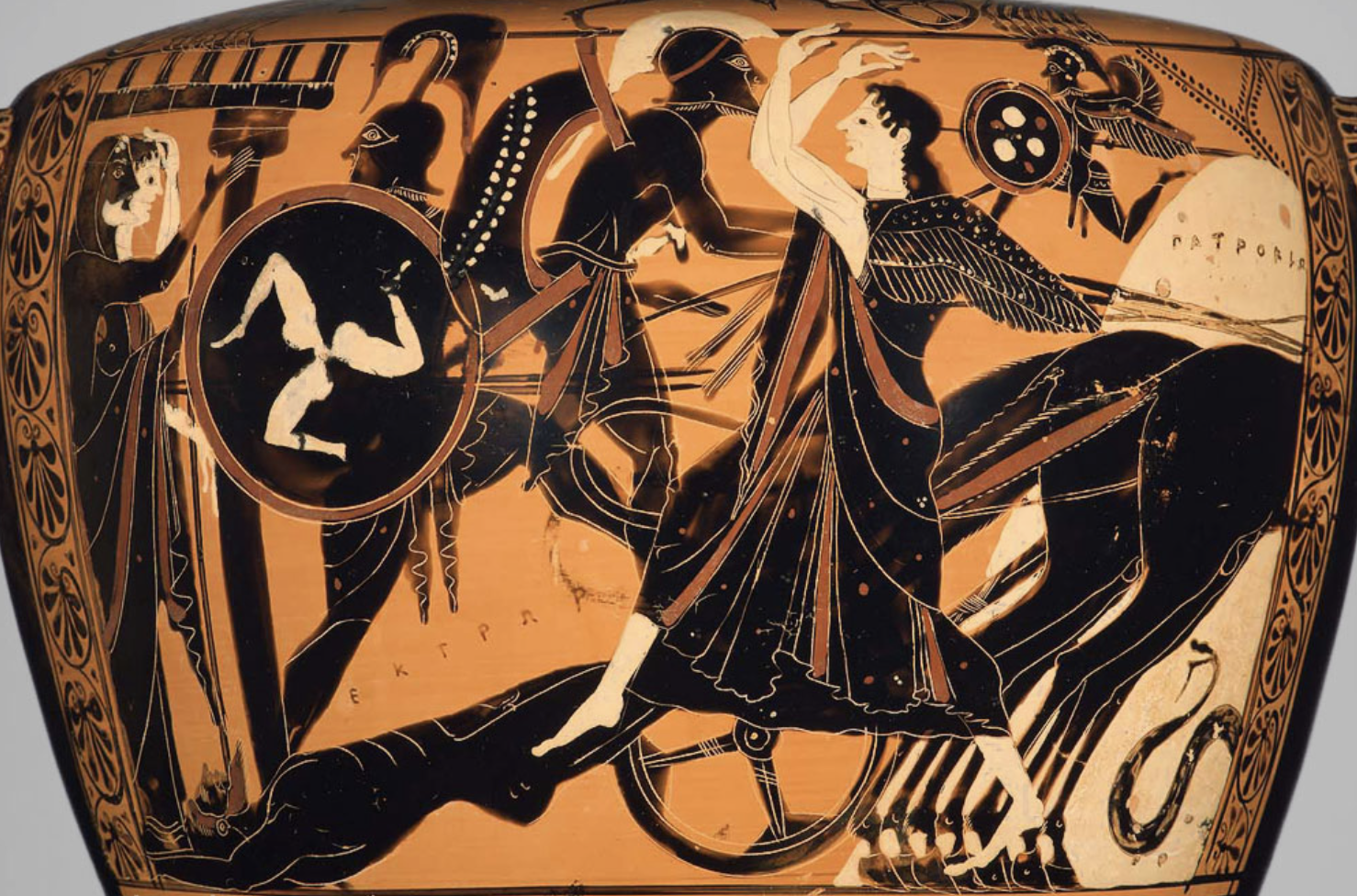
Achilles mounts the chariot with Hector’s corpse lying below, preparing to drag the body around Patroclos’ tomb (right: note the tiny “soul” of Patroclos above. Priam and Hecuba, Hector’s parents, mourn to the left. The winged figure in the center is usually identified as Iris, who commands Achilles to ransom the body (see next image). Vase (ca. 520 BC) now housed in Boston.
Achilles dragging the corpse of Hector around Patroclus’ Tomb (Priam and Hecuba, Hector’s parents mourn on the left.
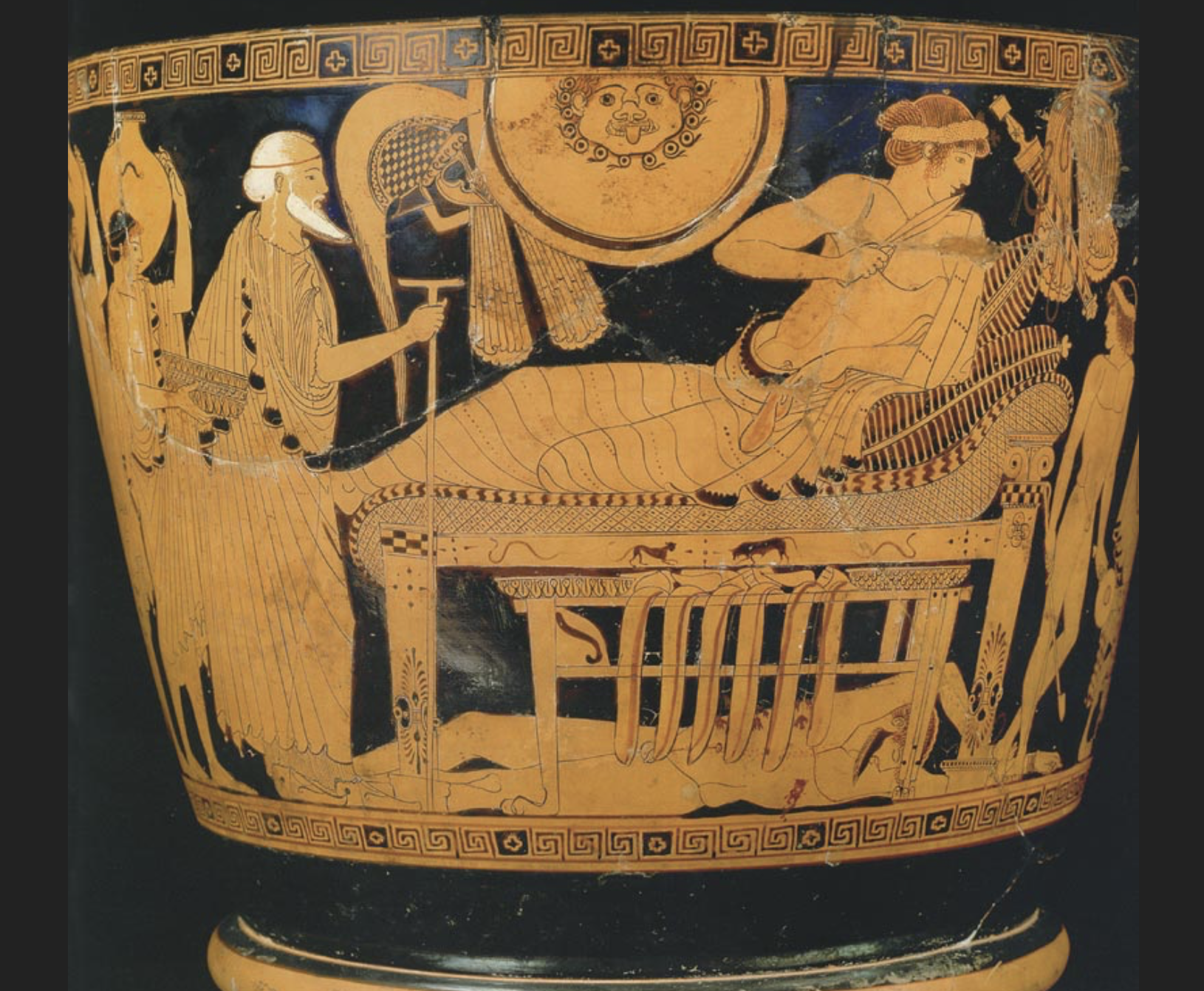
The Brygos scyphos (vase) from around 480 BC, now housed in the Kunsthistorisches Museum in Vienna. Priam approaches Achilles, who seems unaware (Homer shows that Achilles is surprised by the sudden appearance of Priam). Hector’s corpse, horribly mutilated, lies beneath Achilles’ couch.
Translating the Iliad is a challenging task. Well, translating anything is tough. As promised in the episode, here is the original Greek of the opening lines and some translations. Note that the first word of the Greek (pronounced something like may-nin) has ends in an -n- sound. This means that it is the object of the verb, so in English word order we’d say: Goddess, sing of the wrath…. (If it were the subject the ending would be me-nis.) Greek has flexible word order because it is the ending that marks the function of a noun, so Homer could start with this most important word even though it’s not the subject…making it very hard to replicate in English. So, here are some examples, with the more recent examples first:
Greek [with semantic meaning of words in brackets]:
μῆνιν ἄειδε θεὰ Πηληϊάδεω Ἀχιλῆος [rage sing goddess of Peleus’ son Achilles]
οὐλομένην, ἣ μυρί᾽ Ἀχαιοῖς ἄλγε᾽ ἔθηκε [destructive, which countless to the Greeks pains brought]
Emily Wilson (2018)
Goddess, sing of the cataclysmic wrath of Peleus’ son Achilles,
cause of so much suffering for the Greeks,
A. S. Kline (2009 online: poetryintranslation, in prose)
Goddess, sing me the anger, of Achilles, Peleus’ son, that fatal anger that brought countless sorrows on the Greeks,
Stanley Lombardo
Rage—
Sing, Goddess, Achilles’ rage,
Black and murderous, that cost the Greeks
Incalculable pain,
Fagles (1990)
Rage — Goddess, sing the rage of Peleus’ son Achilles,
murderous, doomed, that cost the Achaeans countless losses,
Fitzgerald (1974)
Anger be now your song, immortal one,
Akhilleus’ anger, doomed and ruinous,
that caused the Akhaians loss on bitter loss
Lattimore (1951, artfully keeps the lines the same as the original)
Sing, goddess, the anger of Peleus’ son Achilleus
and its devastation, which put pains thousandfold upon the Achaians,
I have strong thoughts about translation, which is an extraordinarily difficult task, but each of these have their pluses and minuses. Fitzgerald, Fagles, and Lombardo contrive to bring the key word up front: rage (or anger…rage is much better). Kline and Wilson bring the divine inspiration of the goddess—that is, a Muse—to the front. Lattimore, by contrast, brings the imperative “Sing!” to the fore. You’ll also note the different spelling of Achilles. The Greek, transliterated directly, would be Akhilleus (the -kh- is a single letter in Greek, χ, chi). More conventionally the -k- is changed to a -c-, which looks more natural to an English speaker, who conventionally uses the Latin version, Achilles.
The recent translations also use “Greeks” for the Greek word “Achaians.” Homer never uses the term “Greeks,” but instead employs ethnic terms like “Achaians,” “Argives” and “Danaans,” seemingly interchangeably. The brings me to my own formulation of the art of translation:
1) You can bring the reader back to the ancient text. Keep “Achaians” and force the reader to learn this is the Homeric word for Greeks. Keep Greek idioms (may require footnotes!). Etc. In other words, invite the modern reader to learn more about the original world, asking them to do some work. But it tends to feel more “authentic.”
2) You can bring the text toward the reader. Use familiar terms: “Greek” instead of “Achaians;” silently change idioms to fit English readers’ expectations, etc. In other words, make it easier for non-experts to access the main story. Feels more “modern.”
Credits:
Written by Nicole Sanfilippo
Narrated by R. Scott Smith
Sound Engineer and Voice Actor: Jackson Scheele
Music: Jared Sims Brooklyn Tea