
written by Greta Hawes and Scott Smith
Troy finally falls. The Greeks sack the city. And then they head home.
For Odysseus, this is when the trouble starts.
We are still obsessed with Odysseus’ homeward voyage. Christopher Nolan’s The Odyssey is sparking excitement – and controversy. Ever since the trailer was released, commentators have criticised perceived historical accuracies: the American accents; the casting of transgender actor Elliot Page and of Lupita Nyong'o as Helen of Troy; armour that doesn’t belong in the Bronze Age Mediterranean.
The ancient Greeks would have enjoyed these controversies. The Greeks loved arguing about the ‘truth’ of stories. The Greeks weren’t precious about their myths. Greek storytellers could – and did – criticise them. They competed to make people see old stories in new ways. Anyone could claim a traditional story as their own. That’s the nature of myth. That’s the nature of human imagination. That’s what kept these stories alive.
At MANTO, our obsession is mythic geography, so we’ve contributed a piece to The Conversation about where ancient Greeks thought Odysseus went to — and why.
In a nutshell, we argue that Homer describes Odysseus being blown off course by a storm and into ‘the Beyond’, a storyworld more fantastic and strange than the normal landscapes of myth. Nothing is familiar; directions like north and south are meaningless. The Beyond is a storyworld with its own logic, full of eerie, strange and monstrous creatures.
You can’t map Homer’s account of Odysseus’ voyage. The best way to visualise it is as an itinerary, a string of narrative episode, like around the border of the map that Anika Campbell drew for us:
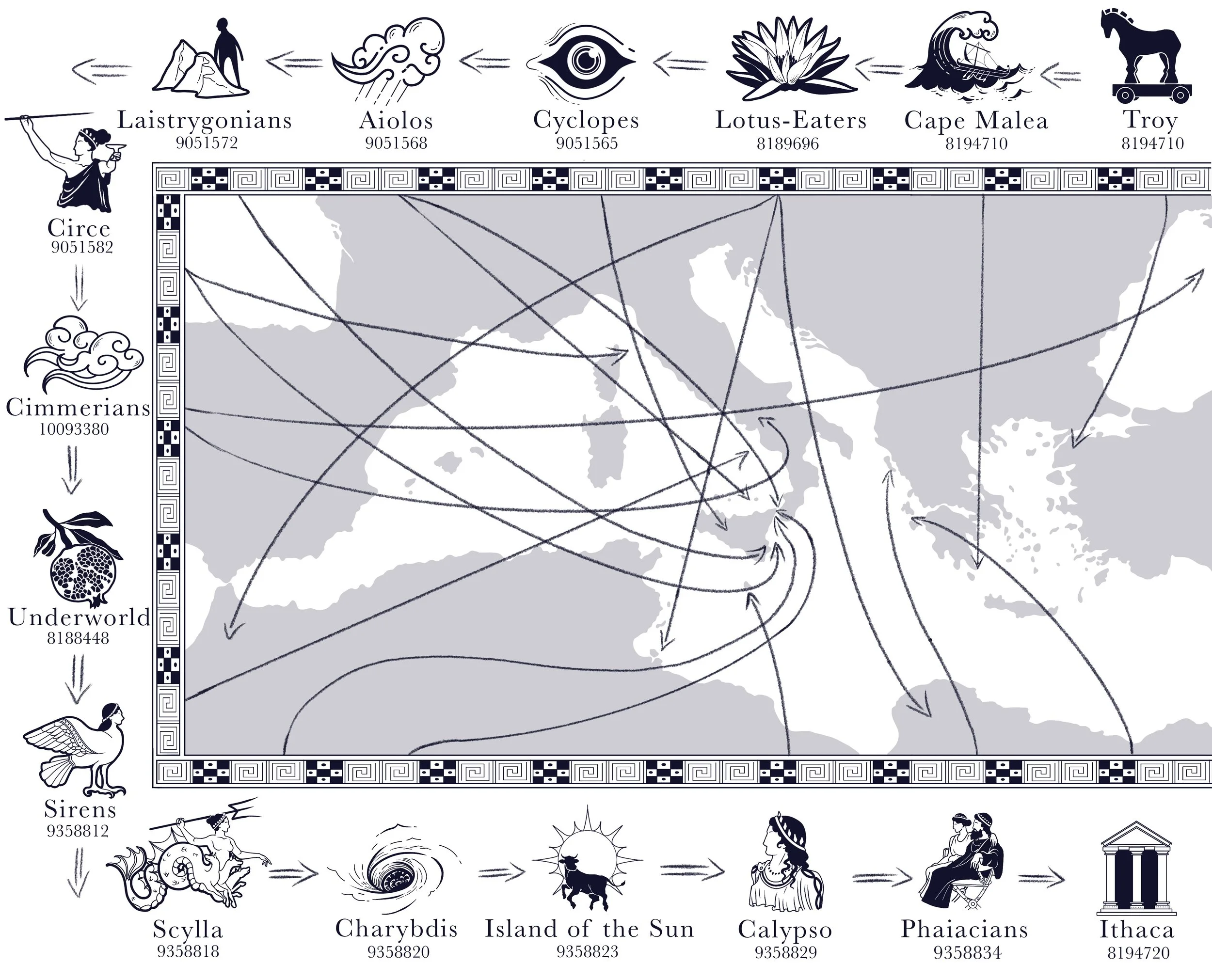
A map of Odysseus’ voyage, showing the narrative episodes around the border, and some of the locations in the Mediterranean that were identified with these stories in antiquity. Image: Anika Campbell.
Of course, Odysseus’ voyage didn’t stay in the beyond. The temptation to claim that Odysseus had travelled to places in the real Mediterranean was too strong. Some of those claims are captured in the arrows on the ma above.
These claims say a lot about the prestige of being able to say that a famous hero had visited some local town. They also say a lot about the Greek preference for locating stories in familiar places, rather than in some mysterious far-off land. And they give us fascinating hints about how ‘proof’ could be found for the truth of myth.
You can read our article in the Conversation here.
And, for a fuller account of how mythic geography works, there’s our recent chapter ‘The data of mythic space’, which includes more of Anika’s fabulous illustrations.
Criticisms of Nolan’s The Odyssey reveal our own culture wars. Too often, a basic question goes unanswered: what does historical accuracy even mean when the story belongs to a fictional storyworld? One way of answering this question takes us to the heart of the Greeks’ understanding of their deep past.