
Double Tombs Of Mythical Heroes
written by Gabrielle Dolphin
My MRes project at Macquarie Univeristy focused on the double tombs of mythical heroes. “Double tomb” is the term I have used to refer to a hero’s body being located in two or more places after their death. This is unusual because, logically, a single body can only be buried in one place. The thesis sought to explain why double tombs existed and the function the tomb had in each city. The thesis focused on exploring the relationships between cities and the use of the mythical past within a city’s present. It demonstrates that double tombs could be used in the competition between cities, represent a collaborative relationship, or could emerge independently. As such, tombs could be used to construct and communicate an identity or relationship with another city, which could be used to the advantage of the city.
For example, Trachis and Argos both claimed the body of Deianeira, the second wife of Heracles. Pausanias favoured the tradition of the Trachians, claiming even the Argive guides were aware that their own version was inaccurate (2.23.6). However, the Argives still maintained the tradition that Deianeira was buried in Argos, highlighting the significance of the tomb.
I argue that the Trachian tradition of Deianeira’s tomb emerged after Trachis became Spartan territory, and the city was renamed Heracleia. This suggests that the tomb of Deianeira served as a physical reminder of the shared connection of Trachis and Sparta to Heracles. This meant the tomb could be used to justify Spartan influence and dominance in the region. Argos and Sparta competed for hegemony in the Peloponnese and were often in conflict. As such, it is likely that Argos claimed a tomb of Deianeira to emphasise its connection to Heracles. This is because this connection undermined Spartan authority while promoting their claim to a prominent hero.
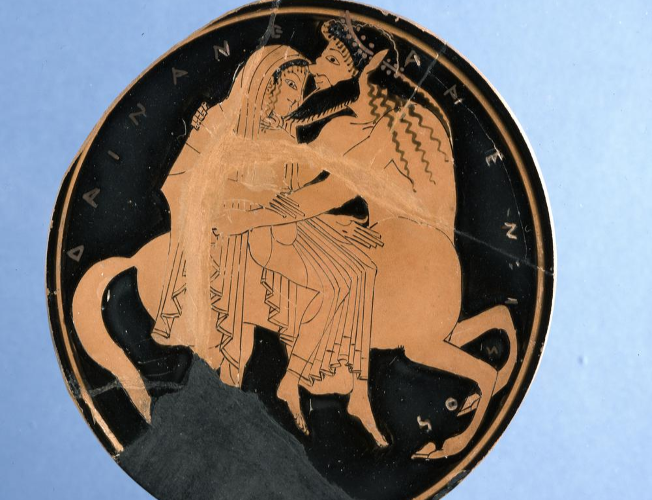
Detail of red-figure kylix depicting Nessos carrying off Deianeira, ca. 520BC-510BC.
Image: The Trustees of the British Museum
Deianeira’s double tombs are just one example of cities using a mythical hero’s tomb to their advantage. Using the MANTO database, I identified 27 instances of double tombs in the Imperial Period, in which at least one tomb is mentioned in Pausanias’ Periegesis. This is currently the largest comprehensive analysis of individuals whose body is said to end up in more than one location. As a result, I was able to identify patterns in the way tombs were used geographically.
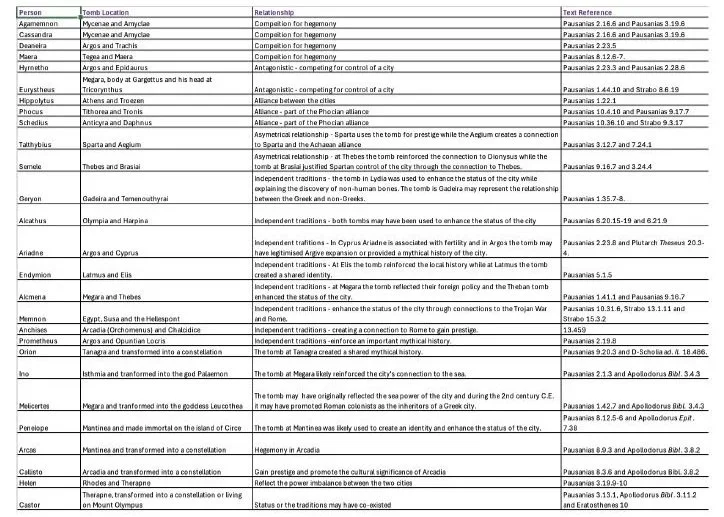
Image of examples of double tombs compiled by Gabrielle Dolphin. For higher quality, see here.
Most of the double tombs in Arcadia, Laconia, and the Argolid were symbols of an antagonistic relationship. The tombs could be used to reinforce claims to being the dominant power, either through promoting its authority or, as the nature of competition changed, to attracting Roman benefactors. In contrast, the double tombs in Phocis may have symbolised an alliance. The double tombs in that region created kinship links that could act as a precedent for aiding the other city. By contrast, the traditions of the tombs located in Boiotia, Elis, and cities outside Greece largely did not correlate with alternate traditions. Instead, the tombs reinforced the identity and mythical significance of the city. Unlike the other regions, the function of the double tombs in Attica varied. Consequently, the thesis concluded that double tombs could be exploited for multiple purposes, reflecting the local circumstances, meaning the purpose of a tomb could change over time.