
Releasing MANTO data into the wild
written by Ewan S. Coopey
Data release
Thanks to the generosity of Dr Janet Gale, we have been able to institute regular public releases of MANTO’s data.
If you follow this DOI: https://doi.org/10.5281/zenodo.19446255, you will find MANTO’s first ever full public data release (or ‘data dump’) ー essentially a repository with a copy of the data behind MANTO’s public interface. We will continue to publish the most recent dump every month. This is a big deal. The data we have been collecting since 2018 is now available online to download without needing to use an API (Application Programming Interface) or contact the MANTO team directly.
The data
This dump on Zenodo (an online repository for open science) comprises a compressed .ZIP file of .CSV and .JSON files of Objects and Classifications in the MANTO dataset. These files, which are essentially tables of data, were generated by a function developed by Nodegoat, which publishes the data online at https://manto.unh.edu/publication.s/2616/. This ‘publishing’ function also visualises and describes the data model ー that is, the way the data is organised and how the various types of Objects and Classifications relate to each other (which, as you can see from all the blue lines in the publication, is in many different ways!).
This means you can now download tables of data related to all of our artifacts which depict mythic events, for example, or all of the entities (such mythic people, objects, and places). The .JSON files contain all relevant tables and their data for each Object or Classification, as well as their overarching schema, whereas the individual .CSV files contain one specific table. In simpler terms, the .JSON files have all that you (or your computer) needs to understand the data and the relation between tables, whereas a .CSV has just one single table but is easy to read for an (untrained) human.
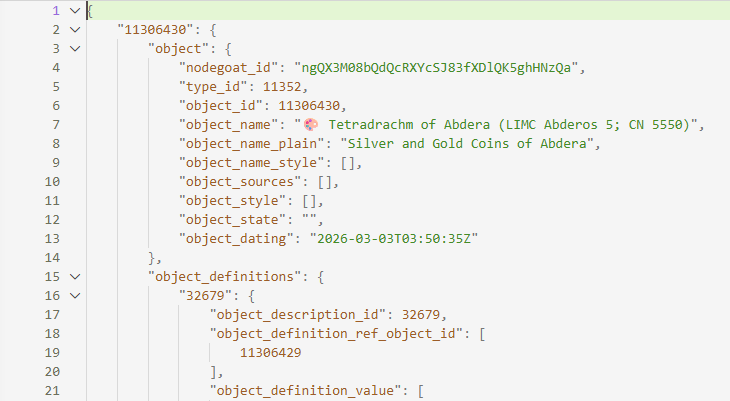
A view of the JSON file for Object: Artifact.
Photo: Author’s own, Microsoft product (Visual Studio Code) screen shot(s) reprinted with permission from Microsoft Corporation.
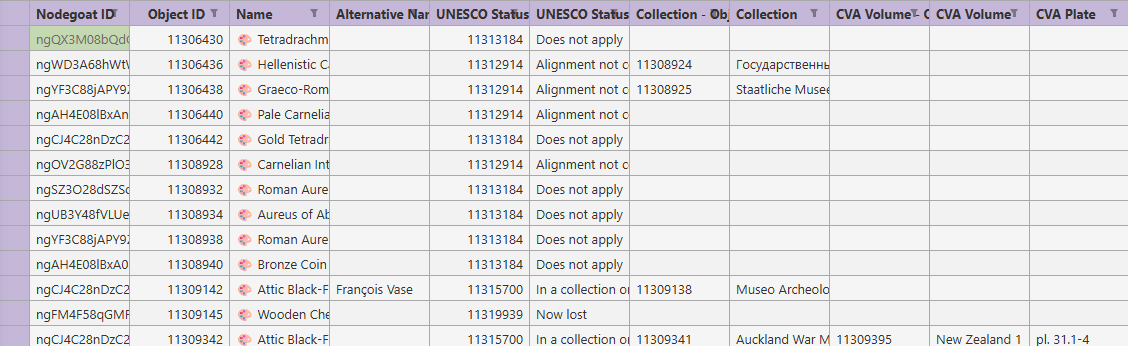
A view of the CSV file for Object: Artifact.
Photo: Author’s own, Microsoft product (Visual Studio Code) screen shot(s) reprinted with permission from Microsoft Corporation.
Access and use
This data is open, shared under a Creative Commons Attribution 4.0 License (CC-BY-NC). This means anyone can now download it and ask questions of the data in whatever way they may wish. In addition to downloading the entire folder or individual tables from the Zenodo or NodeGoat release, you can access the same data via our API. This can be queried at https://api.manto.unh.edu/project/2616/, the schema for which can be viewed on https://validator.swagger.io/.
Now, because MANTO is a relational database (i.e. its tables link to data from other tables) tables will contain values that are defined in other tables and you will probably need to download several tables to understand the data you are interested in. To understand the fields in the database, we recommend that you see the Manual for Data Collection and the Data Management Plan (https://www.manto-myth.org/documentation), as well as the NodeGoat publication (https://manto.unh.edu/publication.s/2616/).
It is our hope that scholars and enthusiasts of the Greek mythical world who have digital skills can now use our data to answer their own complex questions about the mythic storyworld or perhaps add the data to their own datasets. The possibilities are (almost) endless!
This is one of the initiatives to improve MANTO’s usefulness as a public resource that we are able to undertake in 2026 thanks to a generous grant from the Gale Fund at Macquarie University.